Friday, December 17, 2010

eco-friendly and 100% natural burger joint

Here is a neat little book from designer Jim Hargreaves. The book is a design for an eco-friendly and 100% natural burger joint in Denver USA. The story is all about the process that went into designing this stunning environmentally  responsible promotional book. I figured this would be a good blog entry because of the environmentally friendly package designs we did a few weeks back. 

This web site also has some interesting stuff I encourage you guys to explore it a bit. 

http://www.re-nourish.com/?l=project-barnhart_book

Happy holidays, Jessica Murray

Design can change


Design can change is an organization that educates the design community about issues surrounding global warming and its effects such as climate change and promote green design. They provide eco-design guidelines, provide links to sites that educate about sustainability, empower designers to embrace sustainability practices, and eco-friendly cradle to cradle designs.


Call to designers
Take the design can change pledge; it’s a set commitments that you adapt to your daily design practices. Learn more and take the pledge.


The Community’s Part
The organization provides a directory of designers who have taken the pledge and make effort to change things for the better. Find an eco- committed designer.

RGD - DIAC SUSTAINABLE DESIGN CHARTER

The Sustainable Design Charter created by the Design Industry Advisory Committee (DIAC).DIAC developed the Charter to highlight the critical role that designers play in reducing environmental impacts.
Members of the Design Industry Advisory Committee will: 
1. Raise awareness of the critical role that designers play in creating a Sustainable Ontario.
2. Model the principles and best practices of sustainability in professional practice and in design education. 
3. Empower Ontario's design workforce to help all clients reduce negative environmental impacts.
4. Develop Design for Sustainability research initiatives with DIAC colleagues in partnership with industry, government and education. 
There're some links about
sustainability
The AIGA Center for Sustainable Designis dedicated to providing designers with a wide range of information regarding sustainable business practice.
http://sustainability.aiga.org
The UK Design Council is the national strategic body for design. 
http://www.designcouncil.org.uk
The Designers Accord is a coalition of designers, educators, researchers, engineers, business consultants, and corporations, who are working together to create positive environmental and social impact. 
http://www.designersaccord.org
Design Can Change is an effort to bring together the world's graphic design community to address the issues surrounding climate change. Take the Pledge! 
http://designcanchange.org
Design by Nature - an Australian resource established to inspire, educate and empower Australian graphic designers to work towards more environmentally sustainable practices. 
http://www.designbynature.org
Renourish helps to start the conversation on green graphic design by providing defintions, tips, and links to sustainable resources designers can use to make their work a little greener.
http://www.re-nourish.com
BoDo blogs about the business of design including: starting your own design business (online or off); marketing; dealing with clients; working with printers, photographers, copywriters and other surrounding industries; pretty much anything to help a design business grow. http://www.businessofdesignonline.com
Organic Design Operatives (ODO) is a diverse collective of creative people brought together through the common mission of reconnecting people with nature by design. http://www.themightyodo.com
Spread The Word.Your design superpowers are a force for good.
http://superpower.ning.com

Monday, December 13, 2010

Green Design

The industrial age has to evolve to a sustainability age, and inevitably will do so. This will affect our daily lives in a profound way. Human ingenuity has the ability to redesign everything to reduce our ecological footprint on our surroundings. Graphic designers have an opportunity to participate in this process and help provide communication on how to embrace sustainable practices and adopt a green mindset. A few organizations that have adopted this principle are:  

Design Can Change 
http://www.designcanchange.org/

Here, a graphic designer can take an online pledge and be part of this global green design community. The resources section is a valuable  portal to green resources for graphic designers. Topics such as cradle to cradle, sustainability communications, tips for sustainable design, and so much more are listed.

The Designers Accord 
http://www.designersaccord.org/

This is about a global community of designers, business leaders, and educators dedicated to social and environmental issues. Their ultimate goal is to make sustainability a mainstream practice through awareness. There are events, case studies, many articles, and videos, which are all geared to sustainability practices.

Society for Environmental Graphic Design  
http://www.segd.org/#/home.html

A member base of 1,600 strong all dedicated to sustainability practices for the environment. Ensuring that architectural design, signage, exhibit design, etc. all comply with green environmental standards. Publications, conferences, and workshops are available for members as well as non members.


There are many tools and resources for the graphic designer who is looking for ways to design socially and environmentally aware materials. The resources shown above is just an sample of what’s available online. Further your research by searching for other similar resources on the internet, using search terms like 
green graphic designers


Friday, December 10, 2010

LOOP SCOOPS

LOOP SCOOPS was created from Annie Leonard, WGBH, and PBS

Annie Leonard, the creator of the Story of Stuff, as well as its sequels, The Story of Bottled Water, The Story of Cap and Trade, and The Story of Cosmetics have set the Web ablaze over the past few years, thank’s to Leonard’s incredible knack for breaking down complex subjects into witty, easy-to-understand information. And the quirky animation is fun to watch, too.

Annie Leonard is bringing her message of sustainability to kids. She’s teamed up with PBS Kids and WGBH to create eight short animated videos to show kids how to think more deeply and creatively about the world they live in, and how to make choices based on what they discover. Loop Scoops are short, funny videos to get kids thinking about the stuff in their lives and what this stuff can do to the environment. Each SCOOP tells the story of something kids use or see everyday. There goal is to get kids thinking in new ways and asking new questions, like: What is this made of? Where did it come from? Who made it? What happens when I throw it away?

There are 8 different SCOOPS to watch:
Electronic Gadgets
Juice Boxes
Magazines
Orange Juice
Frogs
Garbage
Happiness
Velcro

To learn more, kids can join other ways to help save the environment, check out other websites just for kids: Catalog canceling challenge: Join a movement of kids who are canceling catalogs to save the environment.

The Greens: A site for kids about looking after the planet
Zoom: A site for kids, by kids with lots of stuff to do.
Fetch: A site with a bunch of games that use science.
Young voices on climate change: youth solutions to the global warming crisis

Tell us what you think
LOOP SCOOPS wants you to tell them what  you think. Which do you like the most? tell them if there are other things in your life that you’re curious about. Do you wonder what something is made of? Who made it? Where it came from? Or what happens when you throw it away? and they will do their best to investigate and put answers up on the Web site.

Check it out!

Thursday, December 9, 2010

Method Home Products


Method are well-known for their great range of natural household cleaning products.  Their products contain natural cleaners derived from coconut and corn, and they are all biodegradeable. All their bottles are recyclable.


Every single ingredient in their formulas, including the packaging materials, are assessed and scored by the Environmental Protection and Encouragement Agency, an independent research institute led by Dr. Michael Braugart, author of Cradle to Cradle.


Their packaging is not only cool, but it also carries a conscious. By combining beautiful design, healthy values, eco-responsibility, premium fragrance & product innovation, method is able to offer a superior cleaning experience. One that depends on formulas containing non-toxic, biodegradable ingredients.


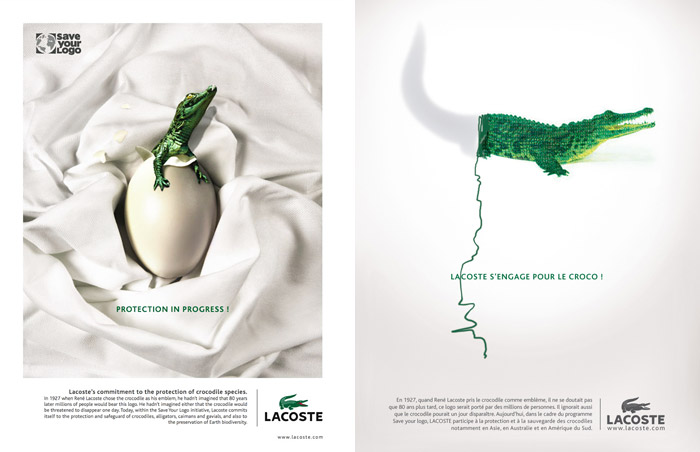
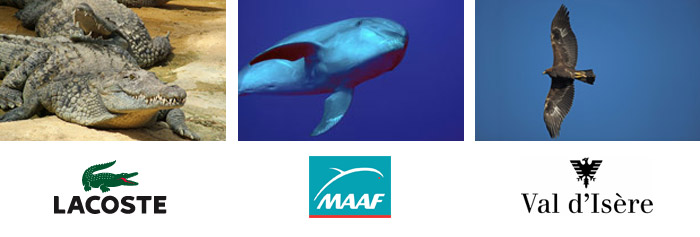
Brands stand behind the endangered species in their logos with Save Your Logo

Renowned companies like Lacoste, MAAF, Val d'Isรจre, Quicksilver & Roxy feature prominent figures in biodiversity in their logos.  Whether it'd be crocodiles, dolphins, birds, even endangered plants, the goal of Save Your Logo is clear — to build an opportunity for these companies to donate towards the conservation of the species represented in their logo.  In works to aid in the preservation of a stronger planet, the vision also emphasises on education and community engagement.


Since the program was developed in France, french brands are currently the top contributors (Lacoste being most notable — founded in 1933).  Moreover, Save Your Logo primarily targets a worldwide audience as they have teams set up in the United States to aid in the vulnerable status of the American crocodile, which have suffered from the recent gulf oil disaster.

"Lacoste is the international brand the most clearly associated with an animal. The brand’s commitment to the preservation of crocodiles seems natural as this animal is part of Lacoste’s history and identity."
— Save Your Logo


How does it work?  A new endowment fund was brought into the French economy in 2008 — this simply allows the option to collect and control any type of donation that is provided free and forever — that being gifts, donations or endowments.

"The device was introduced to spur growth in private fundraising because of the slowness of the French to embrace fundraising possibilities. Even after a new French law was enacted in 1987 to allow private foundations, by 2008, only 3,000 foundations had been created — a mere 20 per year. In contrast to this, fonds are advancing at lightning speed: about 20 per month, the committee reported in May." — The Art Newspaper


This generates ideal opportunities for donations that invest towards the Save Your Logo effort — and with various worldwide discussions involving many companies, it's no doubt that Save Your Logo will have more premium parters to come.  Some other global companies that could easily join include Puma, Jaguar, Esso, Hollister, or even Echo Clothing.